Marker-based Augmented Reality Webcam Model
In this project, I need to design and implement a solution using OpenCV. It relies on keypoint-based image descriptor to match between the image of a structured planar marker and its instance in webcam stream. This post also contains a detailed report of experiments.
Table of contents
- Marker-based Augmented Reality Webcam Model
- How to run the project
- Problem statement
- Theoretical study
- Experiment
- performance
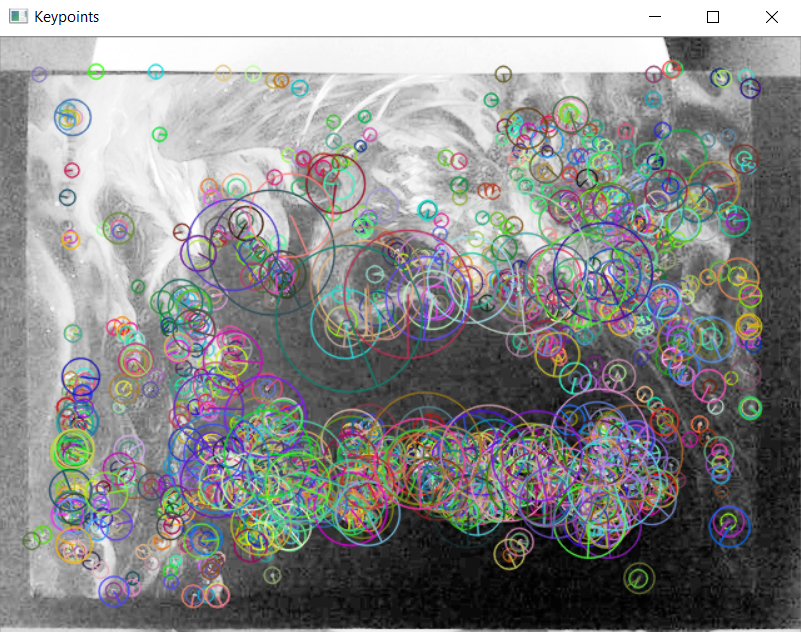
- SIFT keypoints with simple detail sample under light environment
- SIFT keypoints with rich detail sample under light environment
- performance comparison with rich detail sample under dark environment
- performance comparison with simple detail sample under dark environment
- performance comparison with rich detail sample under light environment
- performance comparison with simple detail sample under light environment
- AKAZE performance with default parameters
- BRISK performance with default parameters
- ORB performance with default parameters
- SIFT performance with default parameters
- SURF performance with default parameters
- Rotation & scale
- Varying parameters of descriptors
- Descriptor Matchers & Matching filters
- performance
- Final solution
- Conclusion
- References
How to run the project
This project use opencv-4.4.0 and opencv_contrib-4.4.0 to execute it. In order to build it, you should modify the corresponding option of project’s property.
An optimal solution executable is ready, in order to run it:
- go to the Release folder: cd MarkerBasedAugmentedReality/x64/Release
- put into this folder the sample image and target image
- run with following syntax: ./MarkerBasedAugmentedReality.exe -i [sample_image_name] -i [target_image_name]
There are several trackbars for the optimal solution:
- Has Prep: whether to do sample image preprocessing(CLAHE)
- CLAHE Size: CLAHE tile grid size, should be greater than 1
- Threshold: BRISK’s threshold for keypoints’s detection
- Octaves: BRISK’s octaves number
- Pattern: BRISK’s pattern scale, should be greater than 1
- Filter: 0 for Score Matching, 1 for KNN Matching
- Ratio: ratio for matching filter
- Opacity: augmentation effect’s opacity
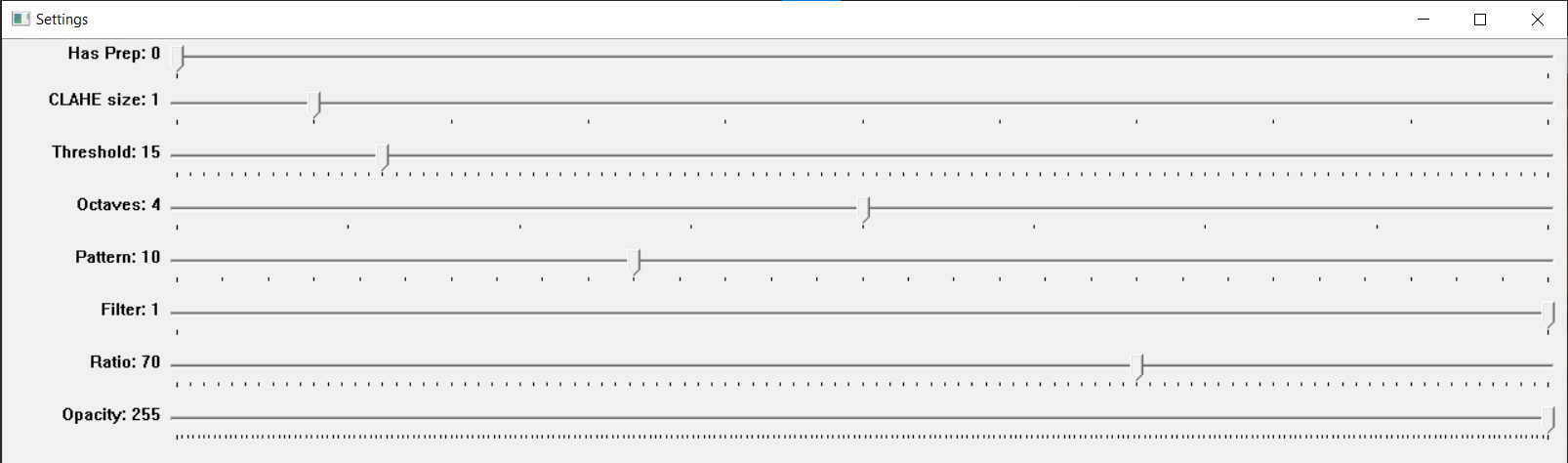
If you want to build the solution with full parameters with possibility of changing the feature descriptor with trackbars, you need to switch on the TEST_MODE in code and build it. In this case, the program may crash down because some descriptors are not working with some matchers.
Problem statement
The problem statement is briefly introduced at the beginning. In order to have a optimal solution under webcam stream utilization, there are several factors to consider about.
- Computation Time This factor is the most important one because in the solution, the detection and matching task should be finished less than 1 frame. The minimum value should be 30 frames per second so that the streaming is fluent enough, that’s is to say, the maximum computation time should be less than 0.03 second for each frame.
- Robustness A robust solution is that the detecting and matching result is generally good for any kind of image inputs. In this project, a robust solution should not have much jittering when the instance is stable.
- Rotation & Scale Invariance It is normal that the instance in webcam will be rotated or shown in different size. Therefore, a feature detector that has rotational variance or scale variance should not be considered.
- Light Condition Sometimes the situation that the lighting is not ideal will happen, no matter for sample image or for webcam usage.
- Motion Blur A common situation for webcam is that the object will move slowly or fast sometimes. The quality of detection should be considered even the object is moving. In this project, I choose a hard book cover with rich details and another with much less interest points as objects to test.
I choose SIFT, SURF, ORB, AKAZE and BRISK as the feature detectors and carry out the experiments. The Harris Corner Detector[1] and Shi-Tomasi Corner Detector[2] is eliminated because of their scale-variant feature.
Theoretical study
SIFT(Scale Invariant Feature Transform)
SIFT[3] is scale-invariant, which is also good at handling illumination change as well. It uses DoG as an approximation of LoG to calculate local extrema(potential keypoint) over scale[4]. SIFT provides distinctiveness, robustness and invariance to common image transformations such as rotation and scale[5]. It is widely accepted as one of highest quality options currently available, promising distinctiveness and invariance to a variety of common image transformations – however, at the expense of computational cost[6].
The parameters contain nfeatures which is the number of best features to retain, nOctaveLayer which is the number of layers in each octave, contrastThreshold that is used to filter out weak features, edgeThreshold that filters out edge-like features, and sigma that denotes the sigma of the Gaussian applied to the input image. Lowe has given the optimal value for these values in his paper.
SURF(Speeded-Up Robust Features)
SURF[7] approximates LoG with Box Filter convolution calculation, which is faster and is suitable for real-time detecting task. SURF is good at handling images with blurring and rotation, but not good at handling viewpoint change and illumination change.[8] Its implementation is in opencv_contrib repository, in non-free part. Its parameters contain hessianThreshold that denotes the threshold for hessian keypoint detector used in SURF, nOctaves and nOctaveLayers like that of SIFT, as well as two flag extended and upright which denote using extended descriptor and up-right or rotated features respectively.
ORB(Oriented FAST and Rotated BRIEF)
ORB[9] is a binary feature descriptor that came from OpenCV Lab and is basically a fusion of FAST[10] keypoint detector and BRIEF[11] descriptor with many modifications to enhance the performance and scale as well as rotational invariance[12]. It employs the efficient Hamming distance metric for matching and these features make it suitable for real-time feature detection and description.
One of its parameters is nFeatures which denotes maximum number of features to be retained.
AKAZE
AKAZE[13] is the accelerated version of KAZE[14] which uses non-linear scale space to find features. It uses a binary descriptor that exploits gradient information. It is proved to be an improvement in repeatability and distinctiveness compared to previous algorithms.
BRISK(Binary Robust Invariant Scalable Keypoints)
BRISK[6] is another binary feature descriptor. It is different from the descriptors like BRIEF and ORB, by having a hand-crafted sampling pattern. BRISK sampling pattern is composed out of concentric rings. In sampling pattern, long pairs are used in BRISK to determine orientation and short pairs are used for the intensity comparisons that build the descriptor, as in BRIEF and ORB[15]. The parameters contains thresh which is AGAST detection threshold score, octaves that is detection octaves and patternScale.
Brute Force Matcher
Brute-Force matcher takes the descriptor of one feature in first set and is matched with all other features in second set using some distance calculation. And the closest one is returned[16]. The two parameters possible when creating pointer is normType, which defines the computation space. The second parameter, crossCheck, is a boolean and its default value is false. If set true, it will check if the pairs in each detector is the same point.
FLANN-based Matcher
FLANN stands for Fast Library for Approximate Nearest Neighbors. It contains a collection of algorithms optimized for fast nearest neighbor search in large datasets and for high dimensional features. It works faster than BFMatcher for large datasets[17].
Matching methods & filtering methods
Each matcher has match() and knnMatch() to do keypoint matching. The former will find the best match for each descriptor from a query set or the sample image. knnMatch() will return the best k matches for each descriptor.
There will be false matching and the next step is to filter the matches. For knnMatch(), Lowe proposed in his paper[3] to use a distance ratio test to try to eliminate false matches. The distance ratio between the two nearest matches of a considered keypoint is computed and it is a good match when this value is below a threshold, and this value is recommended to be 0.7[18]. For match() we can sort with scores and filter those with lower scores by applying a ratio of matches to retain.
Alignment & Augmentation
In order to replace the matched image with target image, the perspective transformation of matched image in frame image should be found. In OpenCV, the routine findHomography() will compute and return the perspective transformation H between them. We can specify in this method the RANSAC robust algorithm to try different random subset in order to estimate the homography matrix[19]. The warpPerspective() applies a perspective transformation to an image. By putting the destination image with target image, this can perform image morphing.
Experiment
To have a optimal solution, I firstly evaluate the time for detection and matching operations of algorithms above. Each detector pointer is created with default parameters which are supposed to be the optimal ones.
performance
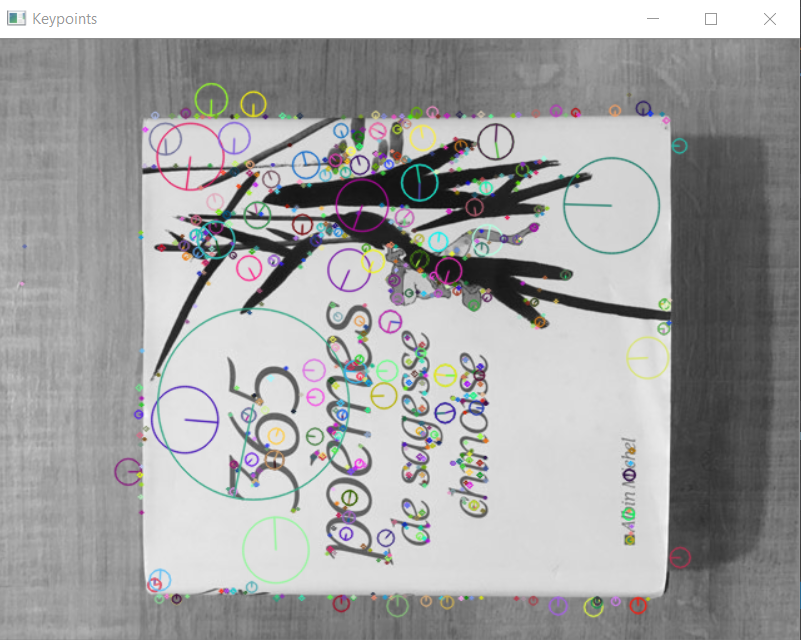
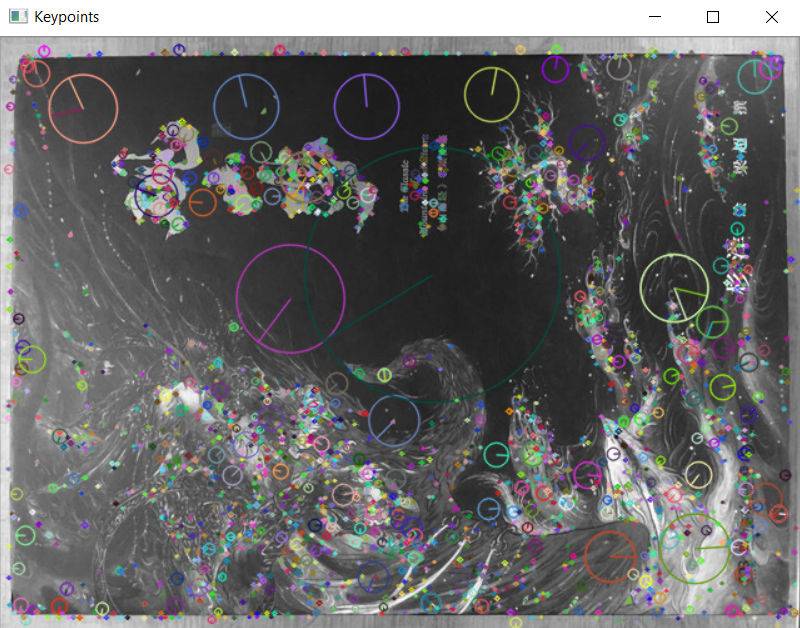
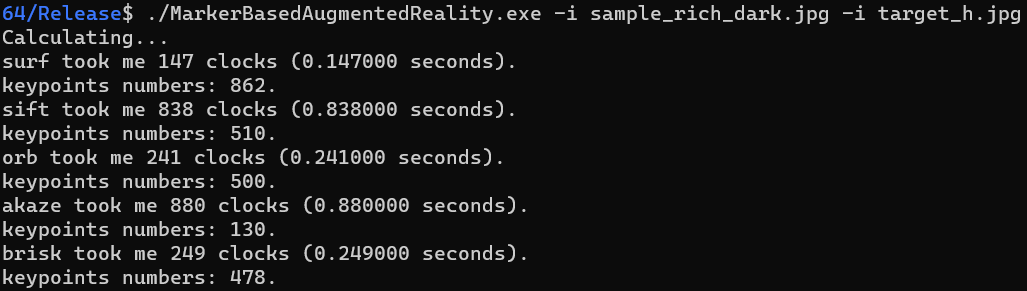
The first experiment is to test the computational time of detection for each feature extractor. My CPU is Intel i5-9300H with clockspeed of 2.40 GHz. The calculation time of detect() function is tested. In source code you can find the KPTest() code implementation. For this test, the variable is the sample image differentiated in lighting and texture(detail).
SIFT keypoints with simple detail sample under light environment
SIFT keypoints with rich detail sample under light environment
performance comparison with rich detail sample under dark environment
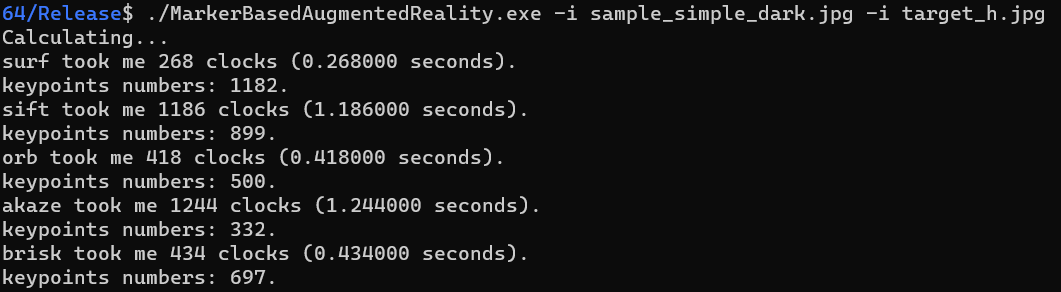
performance comparison with simple detail sample under dark environment
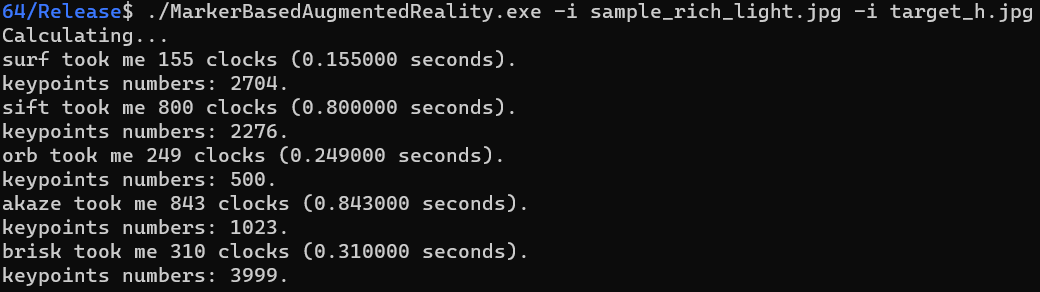
performance comparison with rich detail sample under light environment
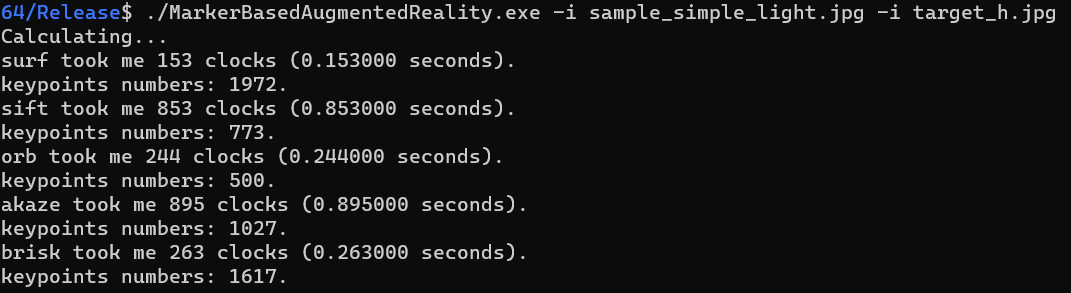
performance comparison with simple detail sample under light environment
From the test above, we can find that the detection time of SURF, ORB and BRISK are at the same level of speed and are much faster than SIFT and AKAZE. Another observation is that SURF find the most keypoints among them.
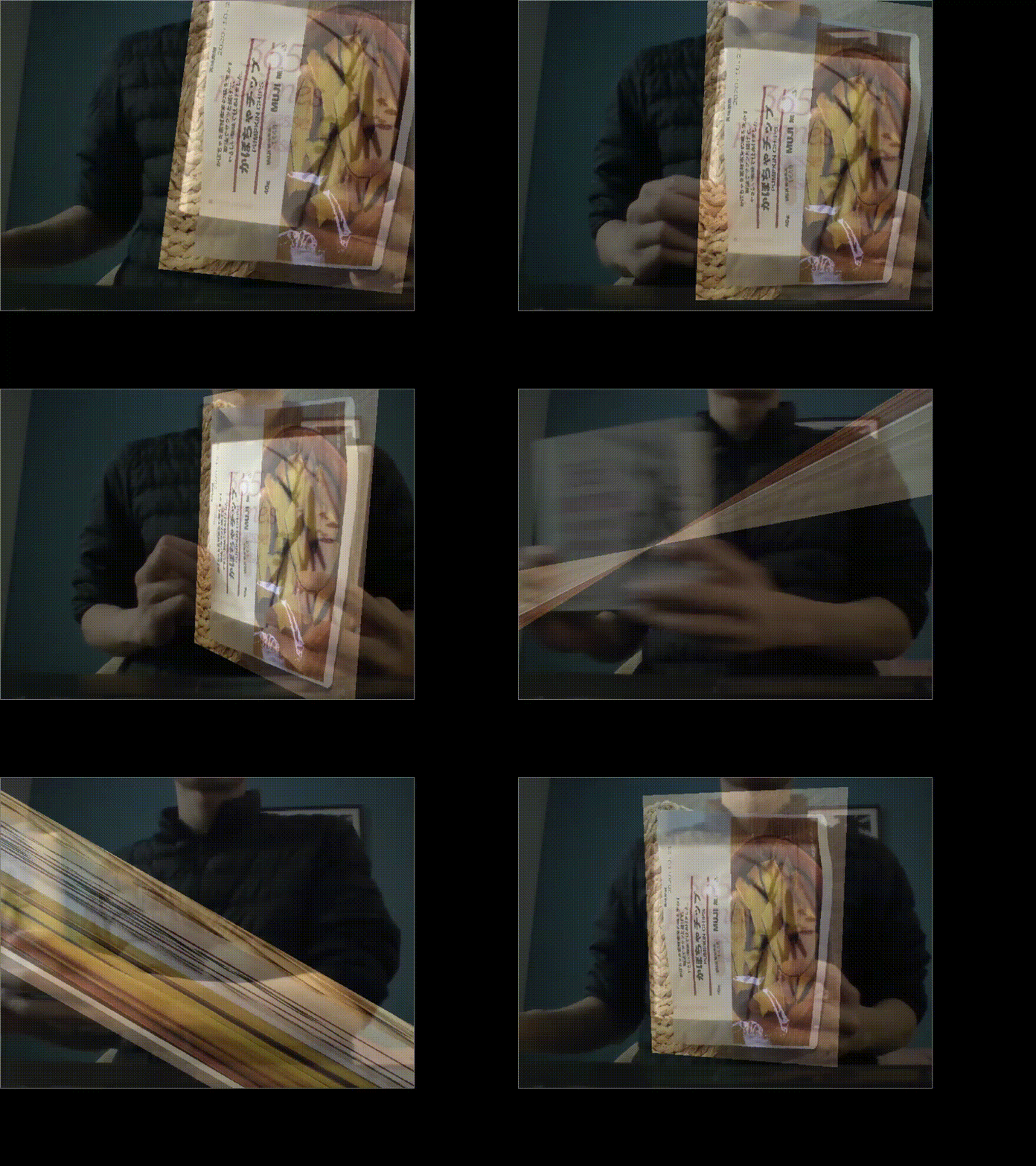
The second test is on matching. For binary string-based feature extractors(ORB, BRISK and AKAZE) I used BruteForce-Hamming matcher, and for floating-point ones I used FLANN matcher, because it is supposed to be faster than Brute Force based matcher for big dataset. The sample image is the one with simple detail under light environment. The matching filter is kNN filtering method where k = 2. The geometric transform is generated by routine findHomography with RANSAC.
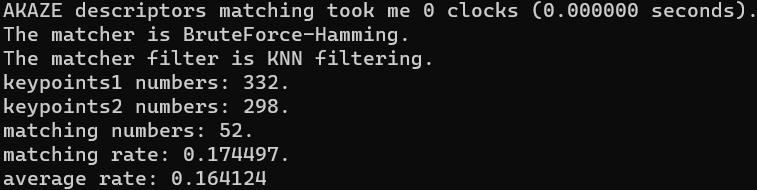
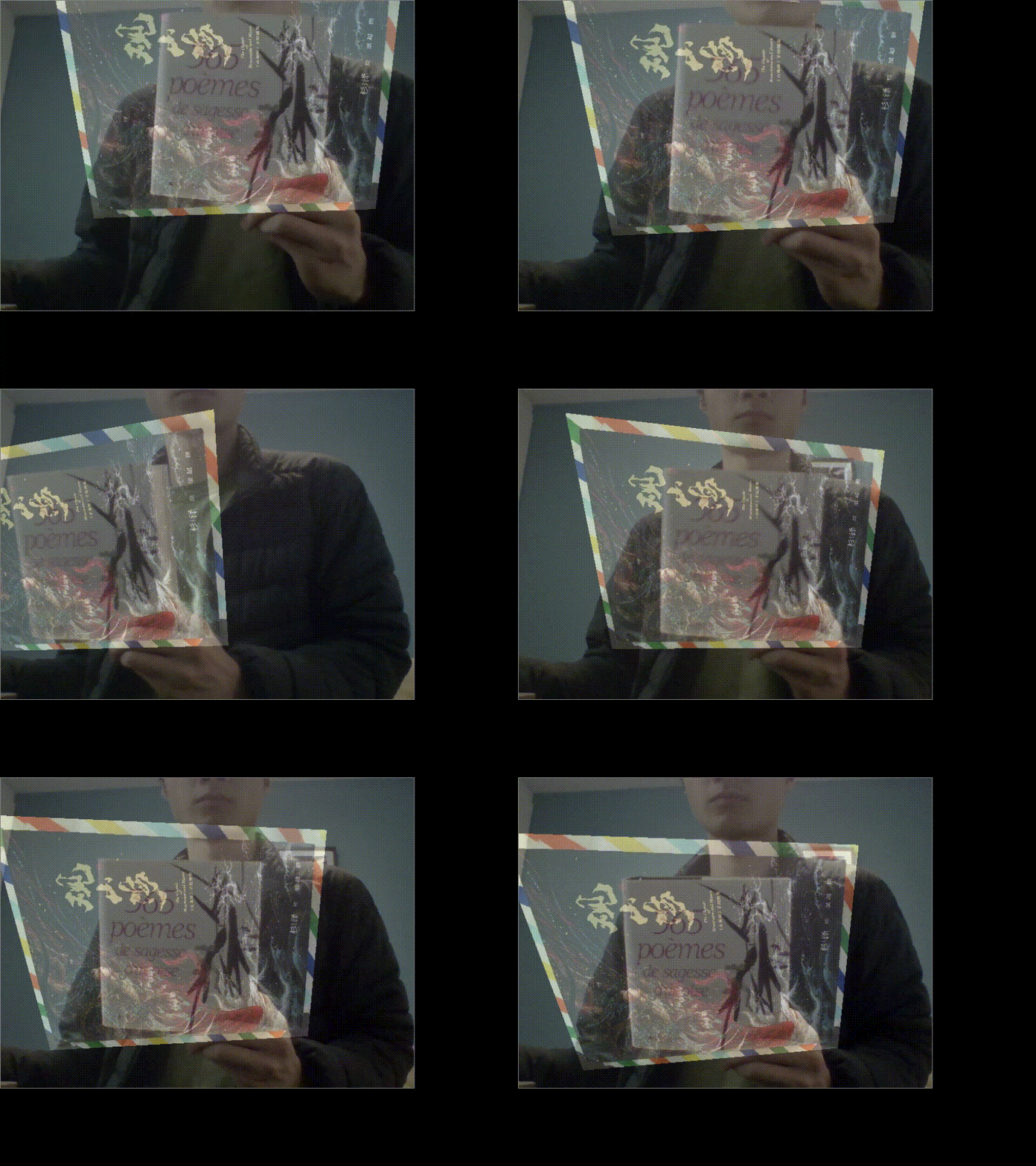
AKAZE performance with default parameters
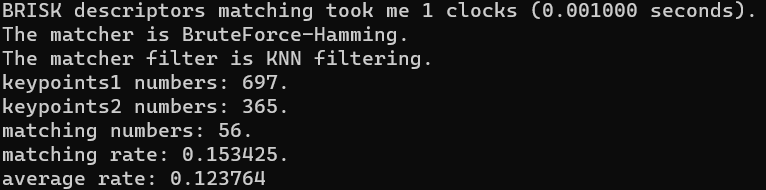
BRISK performance with default parameters
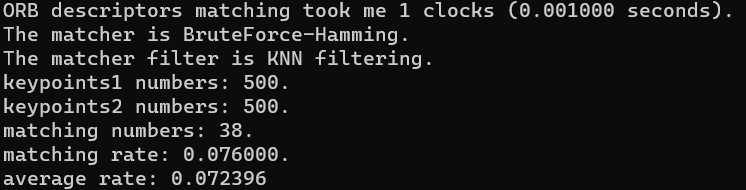
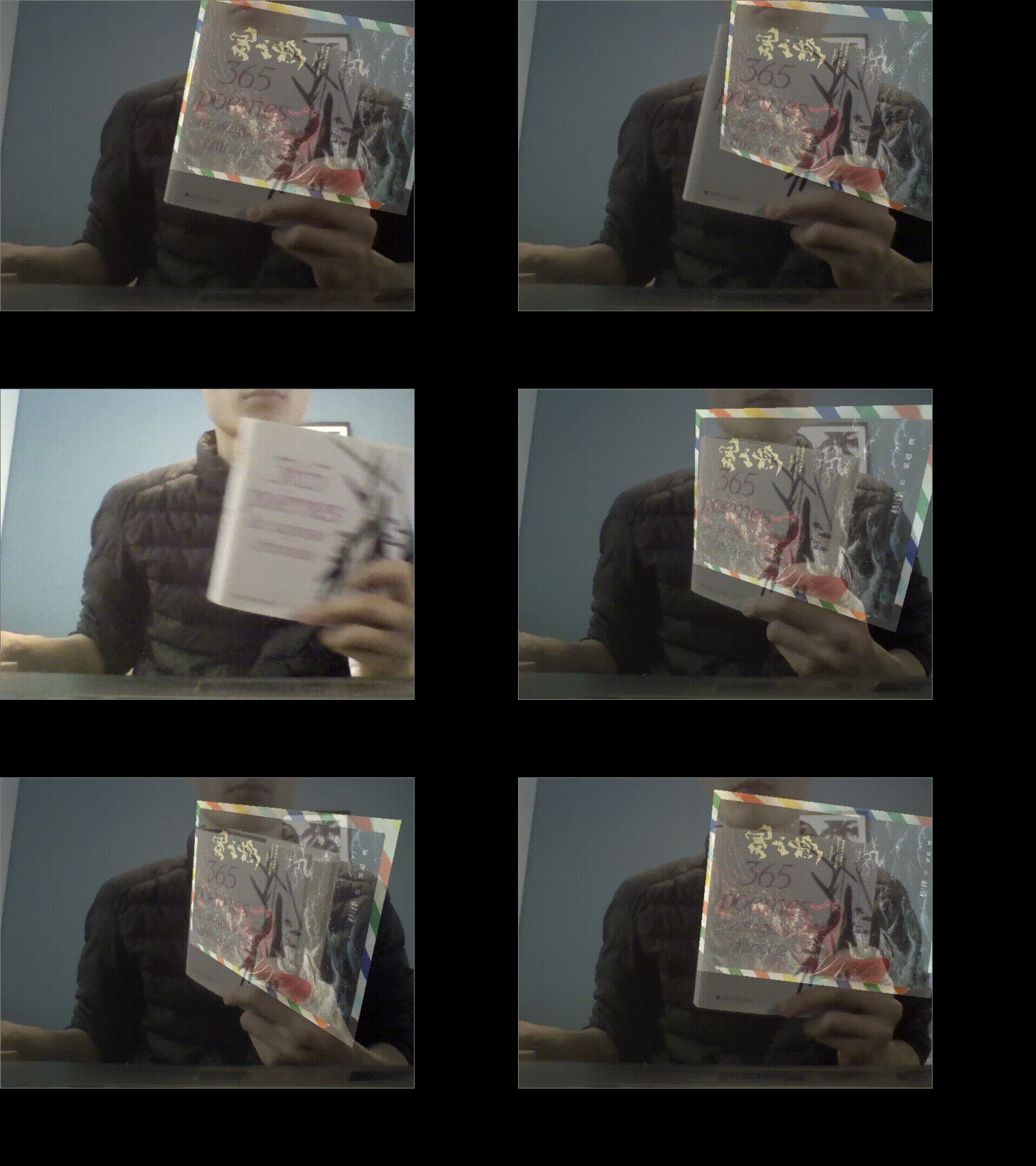
ORB performance with default parameters
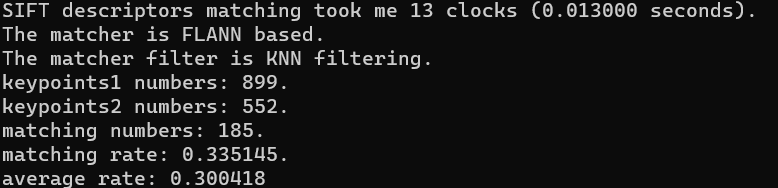
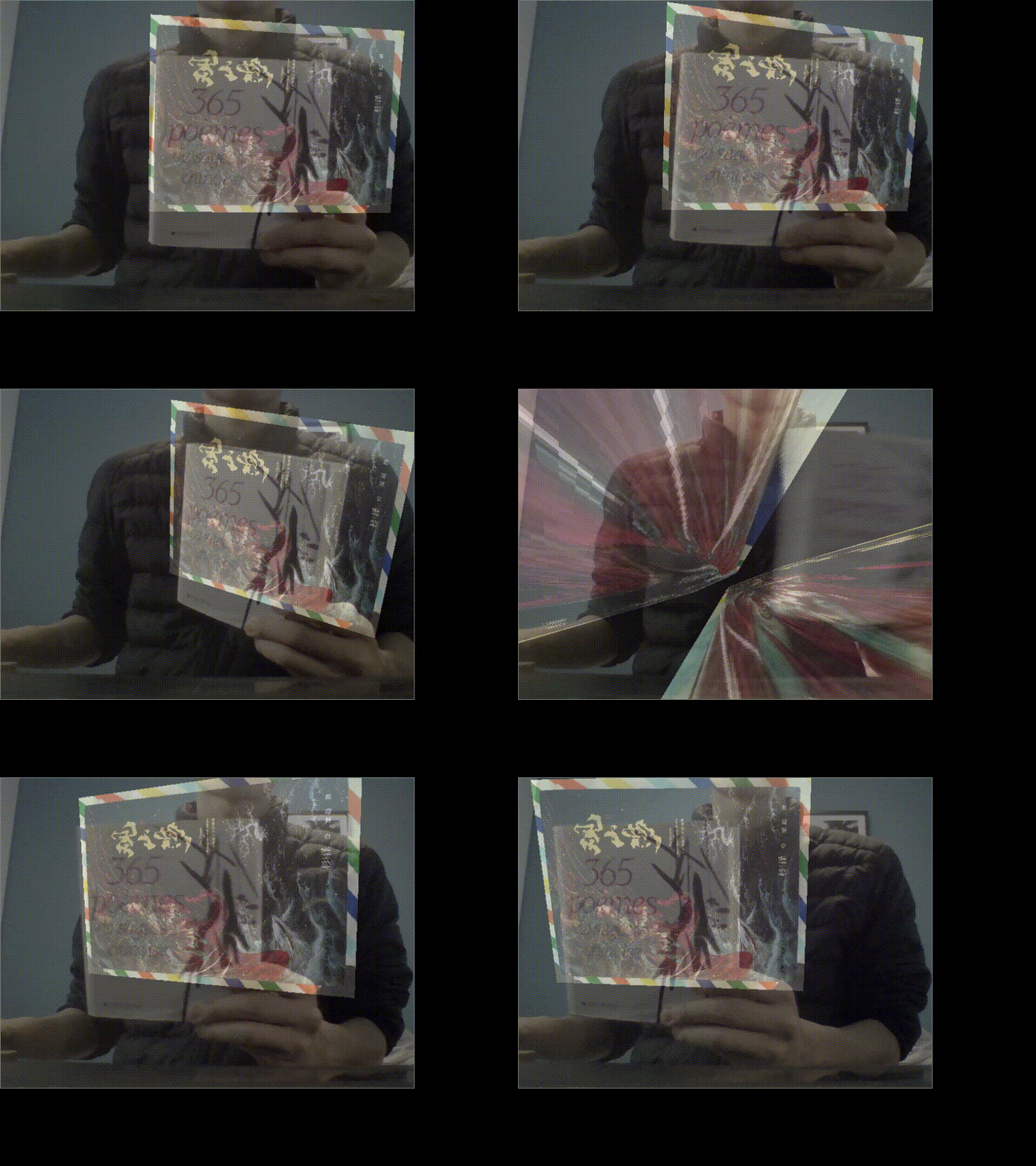
SIFT performance with default parameters
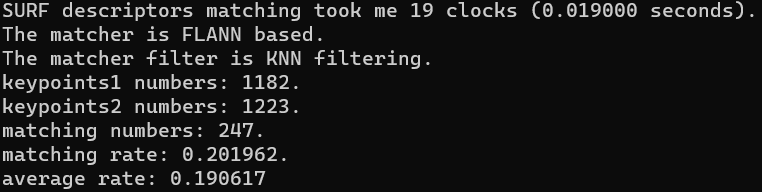
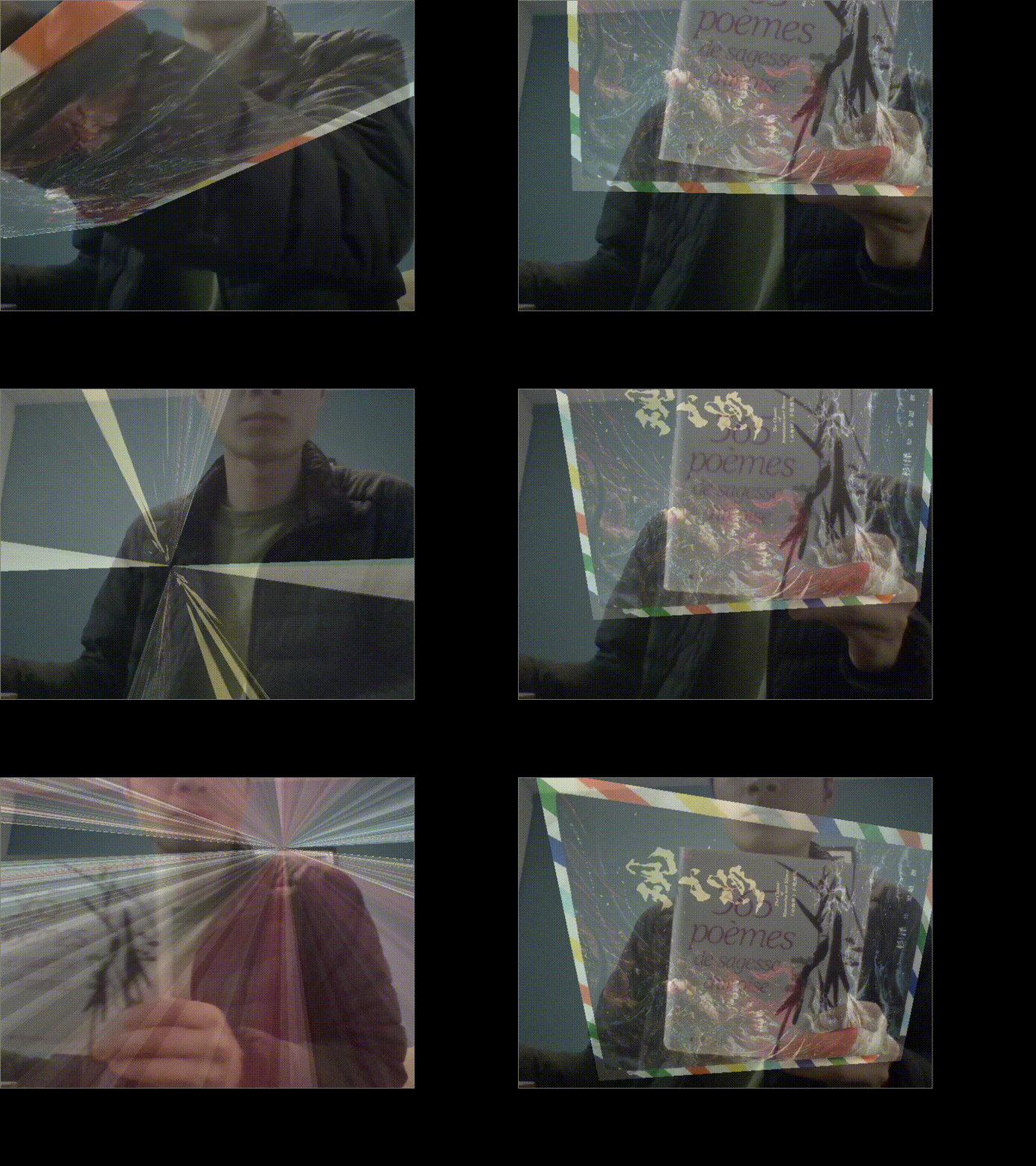
SURF performance with default parameters
From this test we can find that binary string-based descriptors match much faster than that of floating-point-based ones. From observation, I found that SIFT and SURF will influence the fluency of webcam streaming. However, the matching quality(matching rate) is also better. For binary string-based extractors, the BRISK and AKAZE are equally better than ORB in terms of stability. They all have the problem of jittering when moving the instance quickly. With ORB, the matching output will jitter even I hold the book in hand without motion. After this experiment, I decide:
-
Abandon ORB because of jittering.
-
Test with parameters of SIFT and SURF to make the amount of matching less, in order to have less calculation time. According to theory, SURF should be three times faster than SIFT.
-
Try to improve the matching quality to make sure that when I hold nothing, it will not do wrong matching.
Rotation & scale
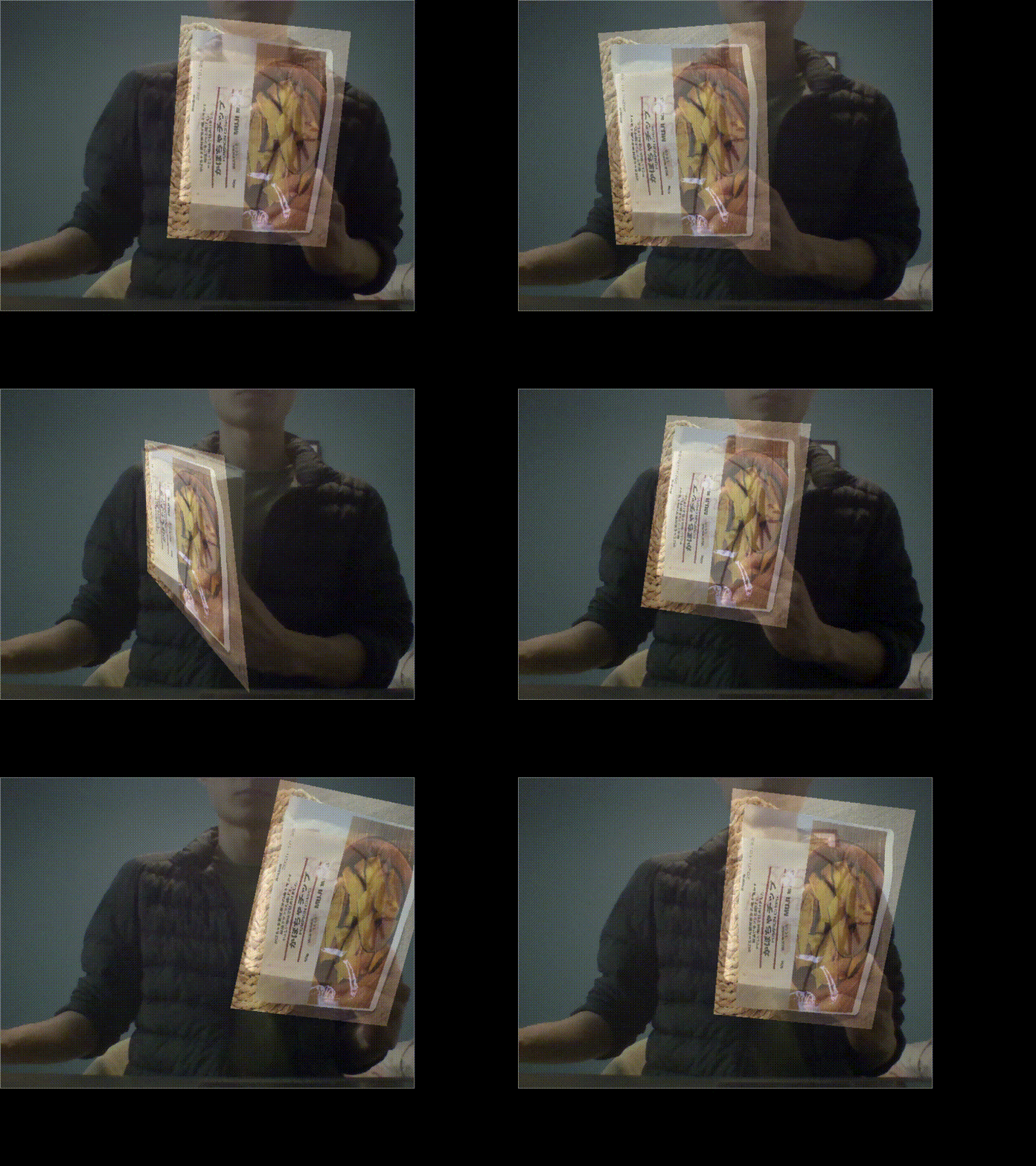
The next experiment is about rotational invariance and scale invariance. At a closer distance, the rotation will not influence much the result of all the descriptors. However, when I move the object away, their behavior differs. For SIFT it is almost the same, but for SURF it is not as robust as before, with some jittering and wrong matching. BRISK and AZAKE is not as good as before. But BRISK is more robust than AKAZE without much wrong matching.
Varying parameters of descriptors
At this stage, I have a general idea of the characteristics of each descriptor. I divide them in to two group:
- SIFT and SURF
- BRISK and AKAZE
For the 1st group, I try varying their parameters to limit the calculation time to an acceptable value(0.16s). At the same time, they should have similar quality of matching without too much jittering.
I test with SURF by varying the value of hessianThreshold, ,nOctaves and nOctaveLayers. By observation, the augmentation of hessianThreshold can be useful to augment the matching rate and performance time. However, it suffers from the jittering problem even the object is stable. What’s worse is that it cannot detect object, if the object is not faced to camera.
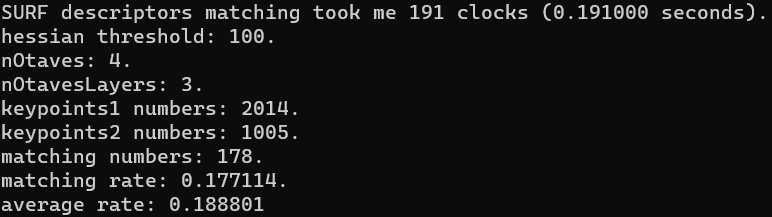
SURF defaut parameters
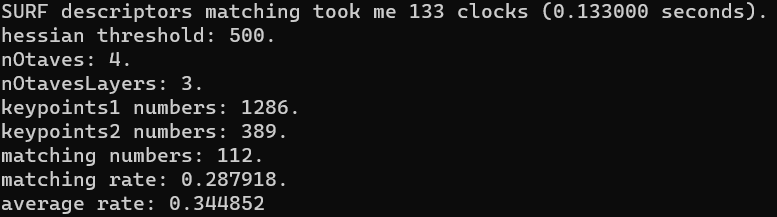
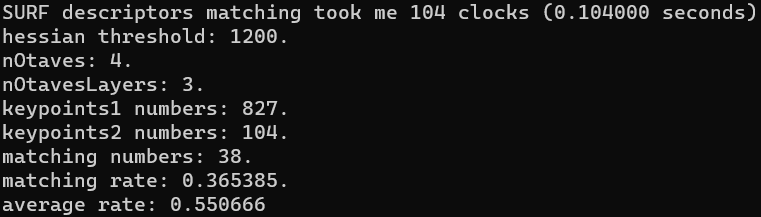
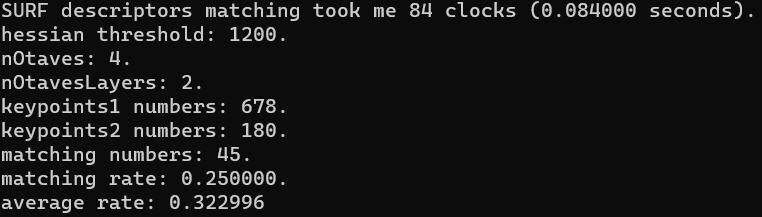
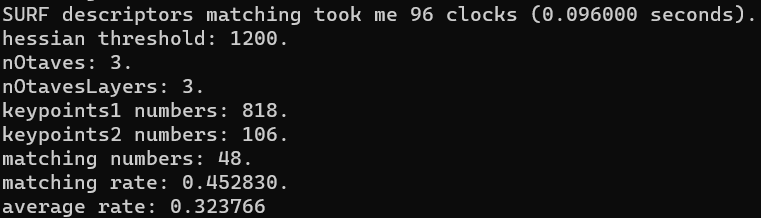
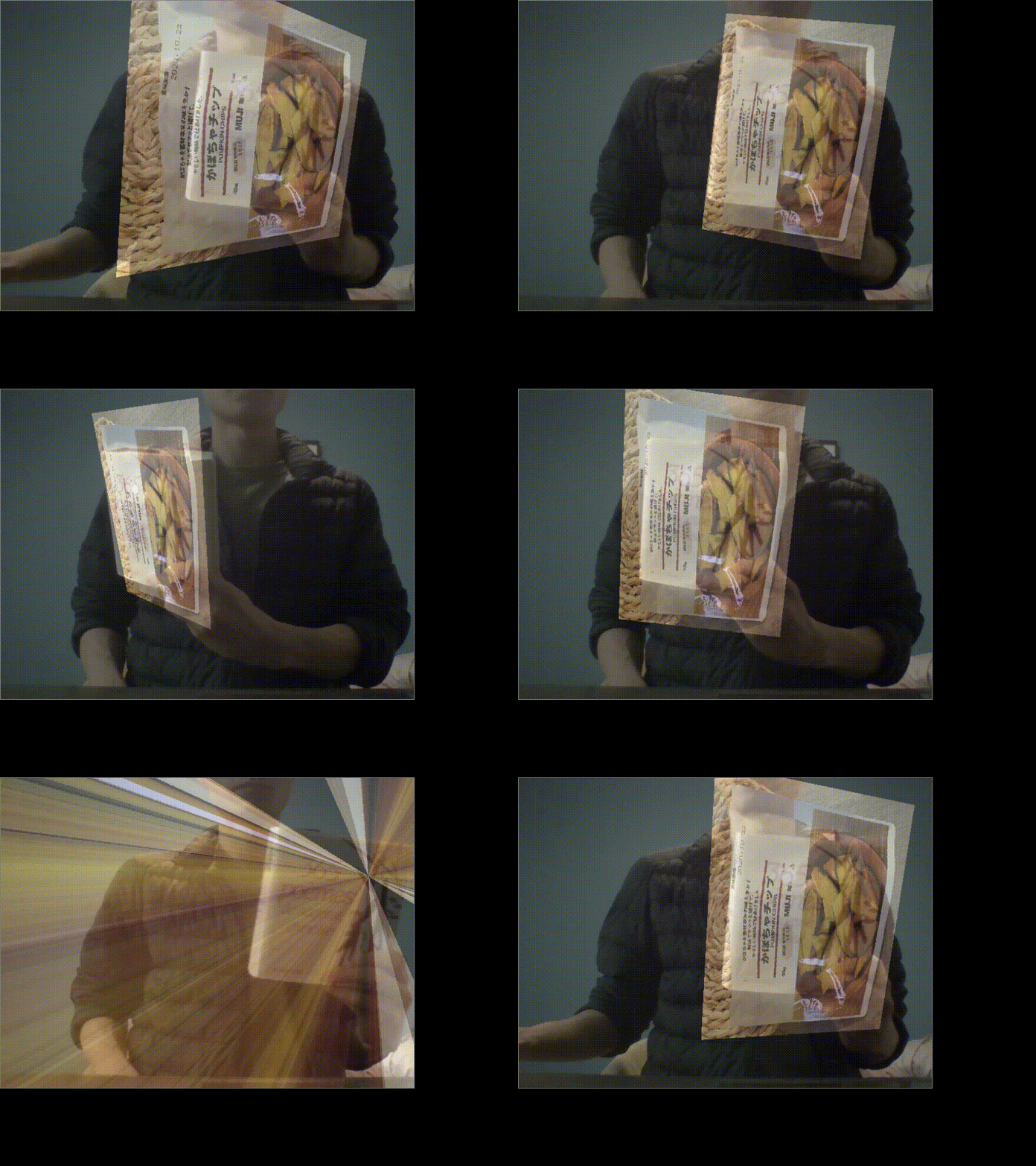
hessianThreshold: 1200, nOctaves: 3, nOctaveLayers: 3
For SIFT descriptor, I use Brute Force L2 matcher because I find that it is faster. There are several parameters for SIFT: nFeatures, nOctaveLayers, contrastThreshold, edgeThreshold and sigma. By varying them I find that the default value is the most robust choice. The change of threshold will make it a bit faster, but it starts suffering jittering.
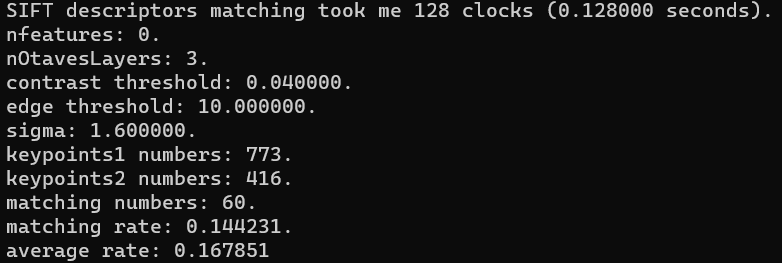
SIFT defaut parameters
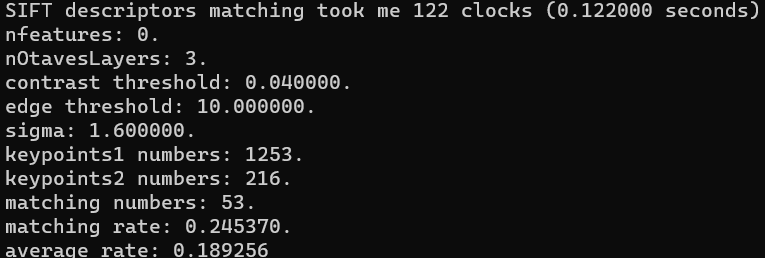
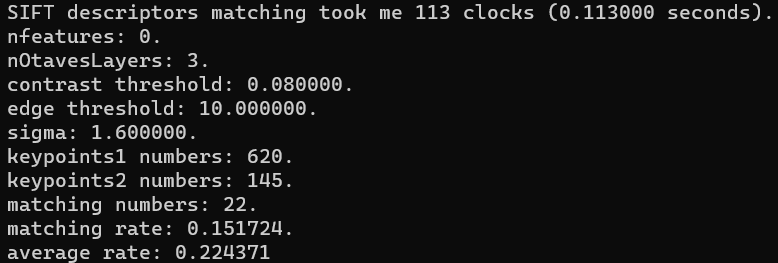
By observation, I find that the computation time of SIFT is similar to SURF, while with a better quality, so I decide to abandon SURF for the solution.
For the second group of BRISK and AZAKE, I try improving their detection and matching quality by varying their parameters.
For BRISK, its parameters are threshold, octaves and patternScale. While decreasing threshold or increasing octaves, the keypoints detected increase which make the matching quality better. Even though the computation time increase to about 0.1s, but for experience it is unrecognizable. With modified parameters, BRISK can achieve a stable matching even though the object is not faced to camera at all.
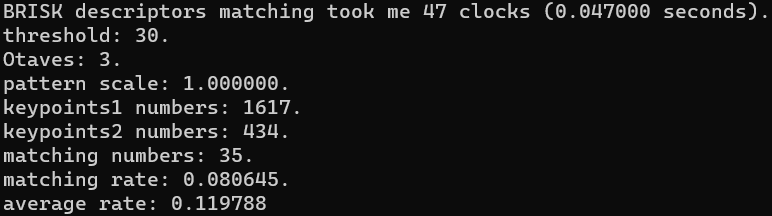
BRISK defaut parameters
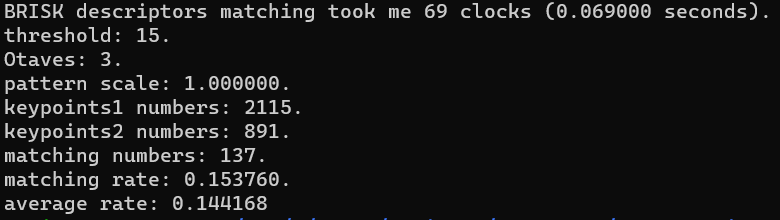
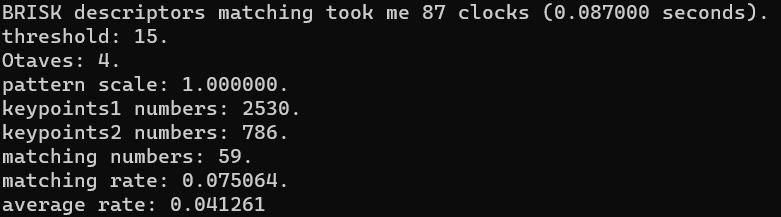
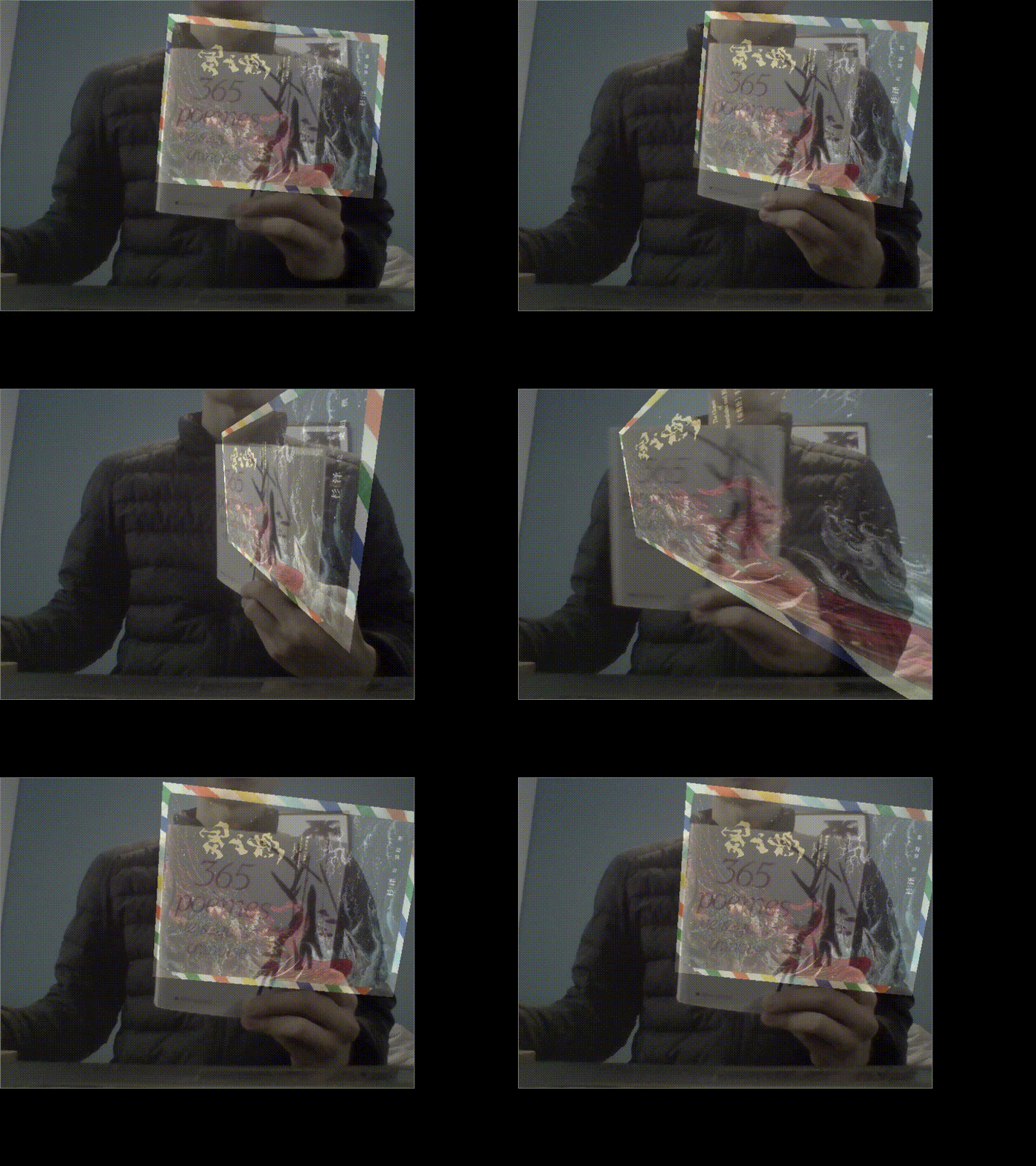
The jittering problem of AKAZE is much worser than BRISK, which is proved by tests above. Therefore, I will not go in deeper for AKAZE in the following experiments.
Descriptor Matchers & Matching filters
When doing experiments above, I used Brute-Force Hamming descriptor matcher, so whether it is possible to use other metrics to get a significant improvement ? The answer is no[20]. But for SIFT descriptor, there are options like FLANN and Brute-Force. The normType BF-L2 are also suitable for SIFT.
The performance of BF-L2 and FLANN is also related to the matching methods and matching filters. Each descriptor matcher has match() function and knnMatch() function, which correspond to best matching and k-nearest-neighbor matching respectively. To filter out the bad matching, they can chooses Score filtering and Ratio filtering respectively.
Here I would like to compare the performance with different matchers without filtering methods for SIFT and BRISK firstly.
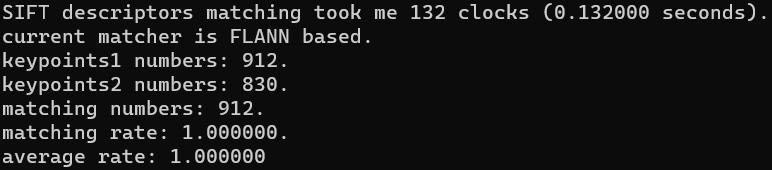
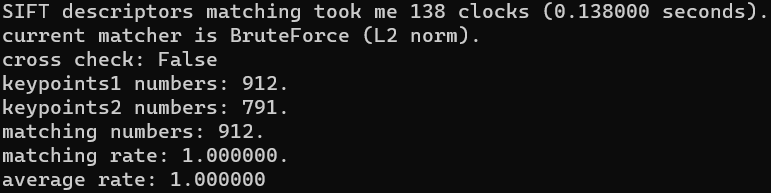
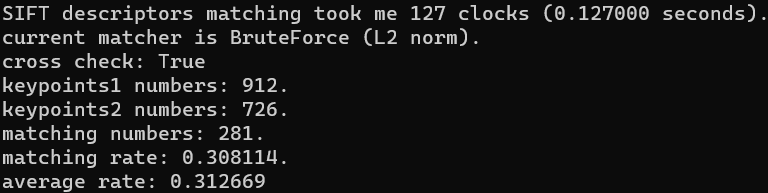
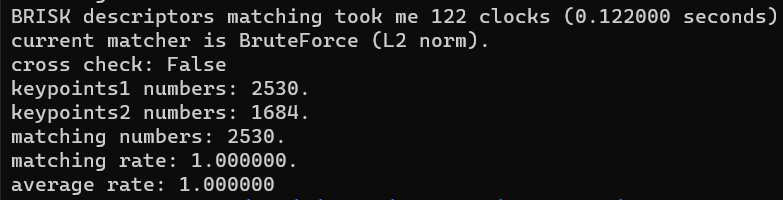
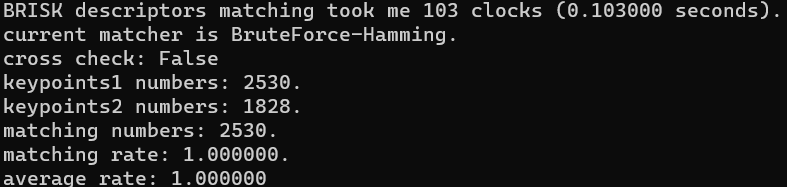
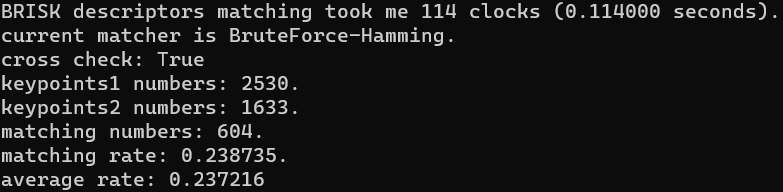
The result shows that the computation time of FLANN and BF-L2 for SIFT is similar, for this sample image. However, with crossCheck activated, the matching quality is much better. For BRISK, BF-Hamming is more quickly than BF-L2.
The next step is to combine match functions as well as match filtering to compare.
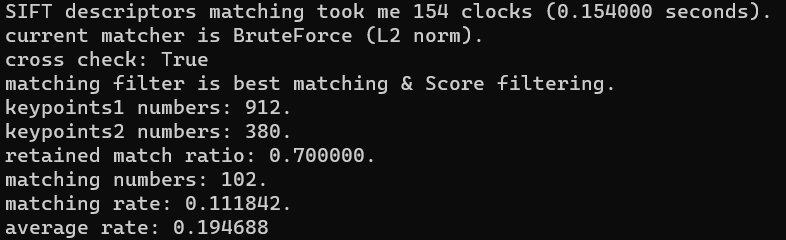
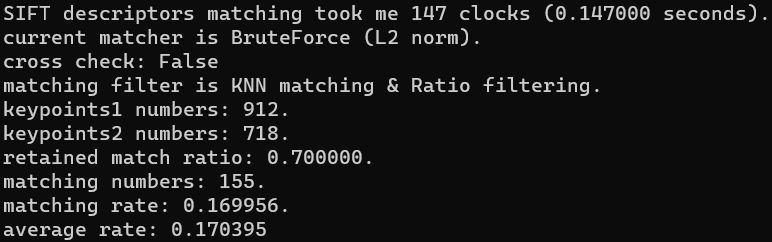
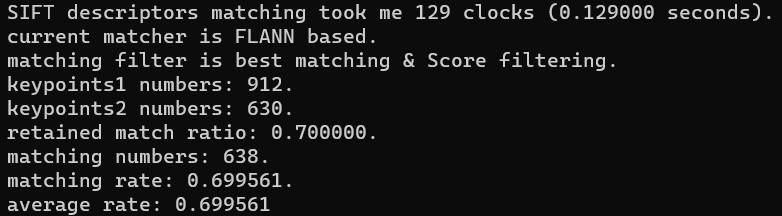
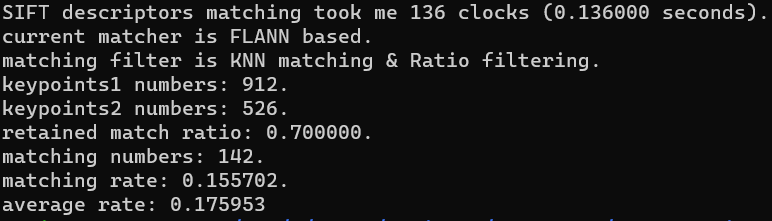
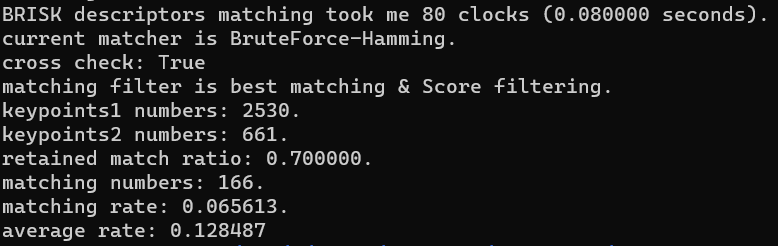
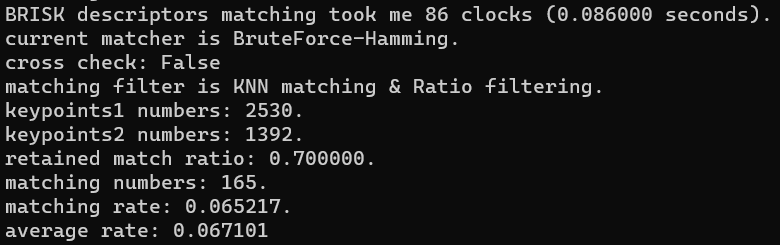
When setting ratio to be 0.7, the computation time is similar between four combinations for SIFT, which are generally 1 times slower than that of BRISK. In this case, I will provide BRISK as the feature descriptor for the final solution, based on the fact that it is faster than SIFT and that its robustness is similar or even better than SIFT. Another fact is that user can still use this solution by adjusting the threshold even they have no a good machine.
Final solution
As final solution, I set BRISK as feature descriptor and BF-Hamming as descriptor matcher. The parameters are the creation option for pointer to BRISK and Matcher filter as well as augmentation effect’s opacity.
At this moment I would like to do an evaluation for its performance with response to different situations. The default parameters are following which is the optimal parameters that I conclude after several tests:
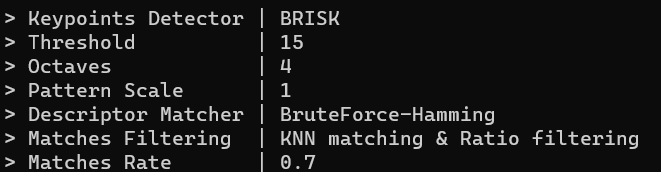
The experiment under normal situation will be also recorded and provided as video at the end of this document.
Calculation Time
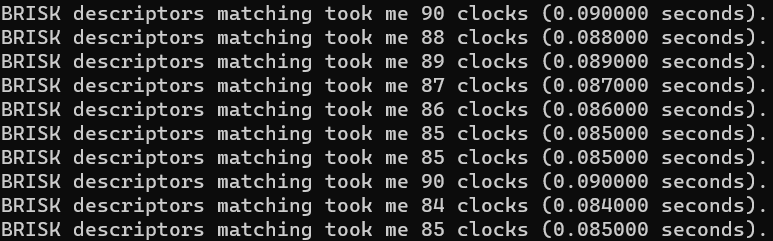
When holding a book without movement, the calculation time is from 80ms to 90ms for my computer with CPU Intel i5-9300H with clockspeed of 2.40 GHz, under a good lighting situation and a simple sample as well as an simple background.
Rotation & Scale
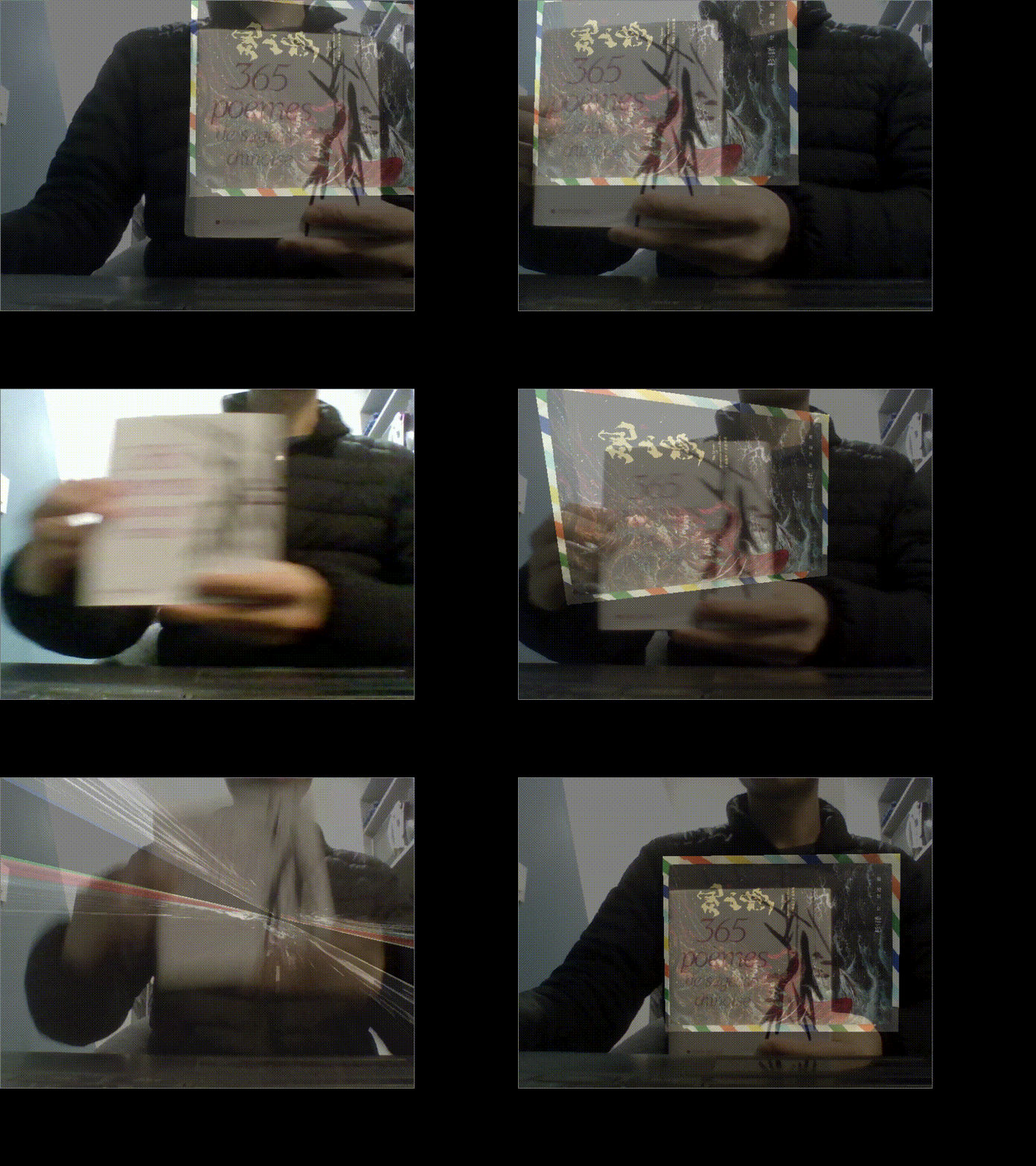
Without rotation, the safe distance from object to camera is about 50cm. From 50 to 70cm, there will be visible jittering. After that the object cannot be matched successfully.
With 180 degree of rotation along the normal direction, the safe distance is about 40cm. From 40 to 80cm, there will be visible jittering. After that the object cannot be matched successfully.
At a distance of 25cm from camera, if the object is rotated along the normal direction to the ground, within 45 degree it is matched successfully without too much jittering. From 45 to 50 degree, it will become unrecognizable.
Motion Blur
With quick motion, the matching will not be successful but will be done once the object becomes stable. With slow motion, the matching will not be interrupted.
Lighting
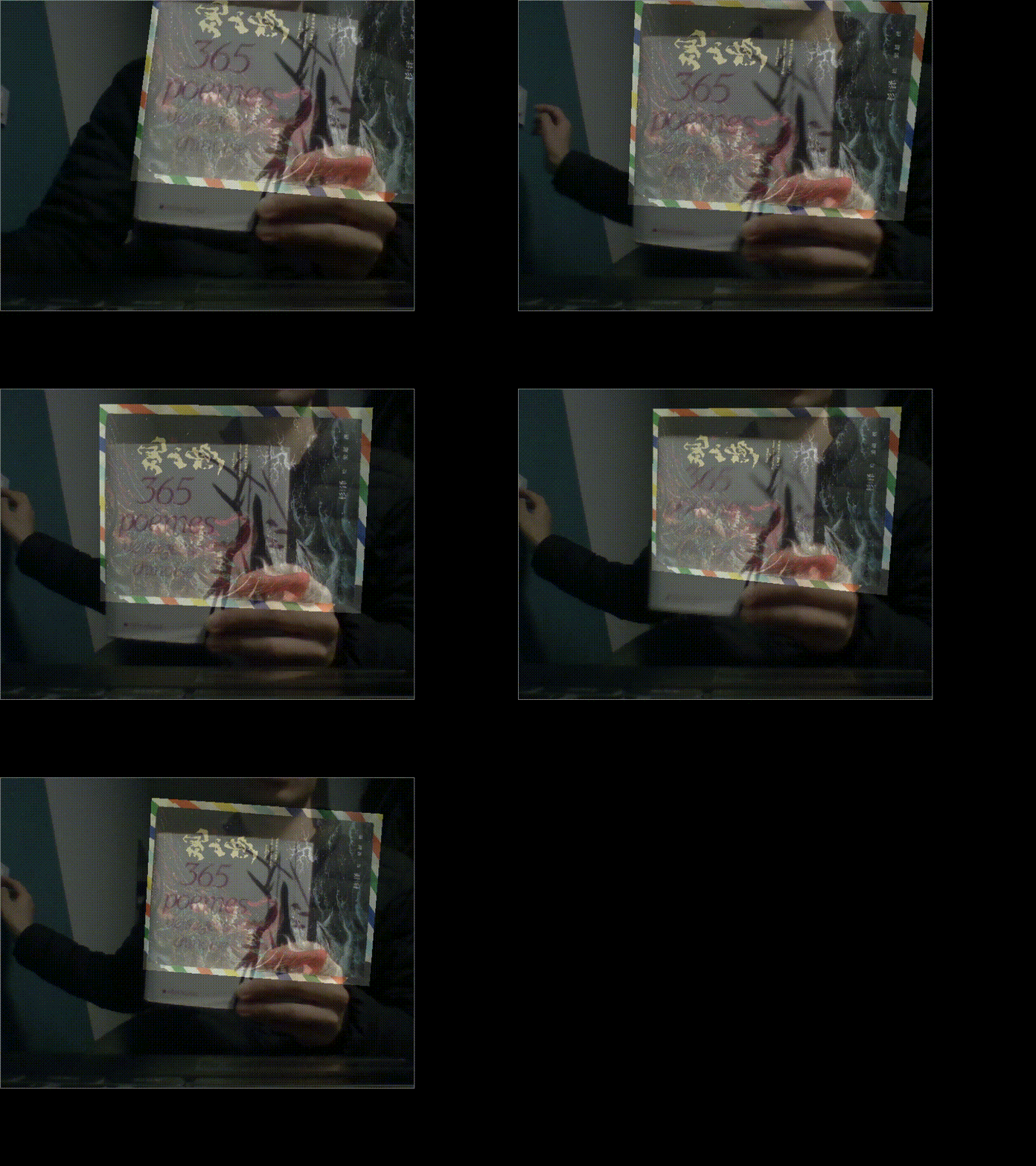
The lighting situation will not influence too much but will result in certain jittering, even there is no light in room, with only screen’s light. It also depends on the object itself. If it is black with many details, the matching will be greatly influenced, but is still can be identified.
Background Complexity
With comparison of putting many objects on background, the matching speed and quality will not be influenced.
Sample Images variation
The sample image will influence the performance. By applying an cover with many details, the computation time will even be doubled but the matching quality is still robust.
Preprocessing
Some sample images need to be preprocessed, so I add CLAHE pipeline to adjust the contrast of luminosity of image.
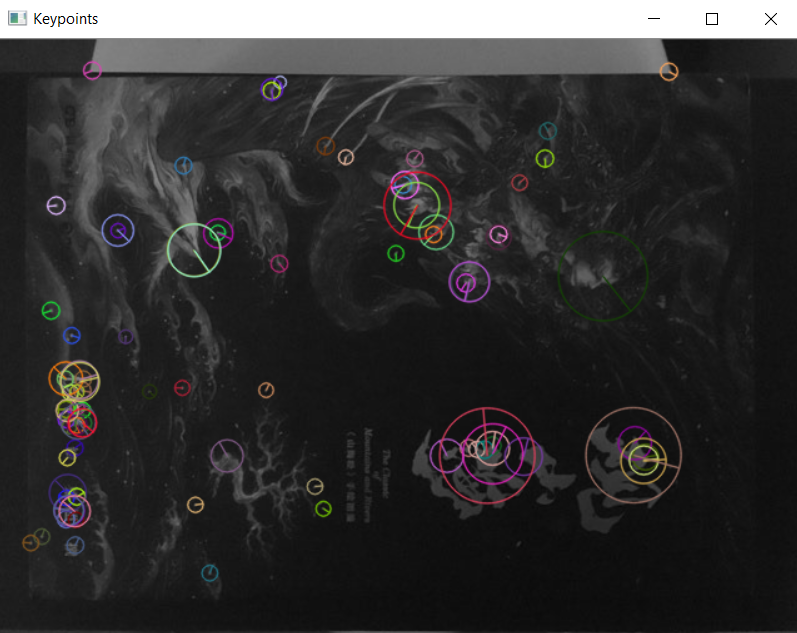
without CLAHE preprocessing
with CLAHE preprocessing
I have tested gaussian blurring as preprocessing but it will not help the detecting and matching. In most cases, it will erase the details and make the keypoints much less than original image. So I do not use it for final solution.
limitations
The first limitation is that, when there is no correct target in scene, the solution will still try matching. The second limitation is that, the computation time will vary according to sample image. However, this can be improved by increasing the threshold to make detected keypoints less.
Conclusion
After doing this project, I have gained a better understanding on state-of-the-art descriptors theoretically and practically. I also learned a basic way to carry out a scientific and quantitative way to do benchmark test of algorithms and the way to document it. Finally, I learned how to evaluate a solution’s performance.
References
-
OPENCV – Shi-Tomasi Corner Detector & Good Features to Track
-
G. D. Lowe. Distinctive image features from scale-invariant keypoints. IJCV, pages 91–110, November 2004
-
OPENCV – Introduction to SIFT (Scale-Invariant Feature Transform)
-
A. Pieropan, M. Björkman, N. Bergström and D. Kragic, Feature Descriptors for Tracking by Detection: a Benchmark, Jul 2016, online
-
S. Leutenegger, M. Chli and R. Siegwart, “Brisk: Binary robust invariant scalable keypoints”, Proc. Int. Conf. Computer Vision, pp. 2548-2555, 2011.
-
Bay, H., Ess, A., Tuytelaars, T., Gool, L.V.: Surf: Speeded Up Robust Features. Computer Vision and Image Understanding 10, 346–359 (2008)
-
Ethan Rublee, Vincent Rabaud, Kurt Konolige, Gary R. Bradski: ORB: An efficient alternative to SIFT or SURF. ICCV 2011: 2564-2571.
-
Edward Rosten and Tom Drummond, “Machine learning for high speed corner detection” in 9th European Conference on Computer Vision, vol. 1, 2006, pp. 430–443.
-
Michael Calonder, Vincent Lepetit, Christoph Strecha, and Pascal Fua, “BRIEF: Binary Robust Independent Elementary Features”, 11th European Conference on Computer Vision (ECCV), Heraklion, Crete. LNCS Springer, September 2010.
-
KAZE Features. Pablo F. Alcantarilla, Adrien Bartoli and Andrew J. Davison. In European Conference on Computer Vision (ECCV), Fiorenze, Italy, October 2012. bibtex
-
Fast Explicit Diffusion for Accelerated Features in Nonlinear Scale Spaces. Pablo F. Alcantarilla, Jesús Nuevo and Adrien Bartoli. In British Machine Vision Conference (BMVC), Bristol, UK, September 2013. bibtex
-
A tutorial on binary descriptors – part 4 – The BRISK descriptor
-
E. Bostanci, “Is Hamming distance only way for matching binary image feature descriptors?”, Electronics Letters, vol. 50, no. 11, pp. 806-808, May 2014.